




What if the concepts students find difficult in the classroom became the concepts they never forget?
A student can memorise Newton’s Laws.
But can they see those laws in action?
A student can solve a mathematical equation.
But can they understand where that mathematics is used in the real world?
A student can read about pollution, water cycles or genetics.
But can they investigate, measure and create solutions around them?
This is where STEAM changes the learning experience.
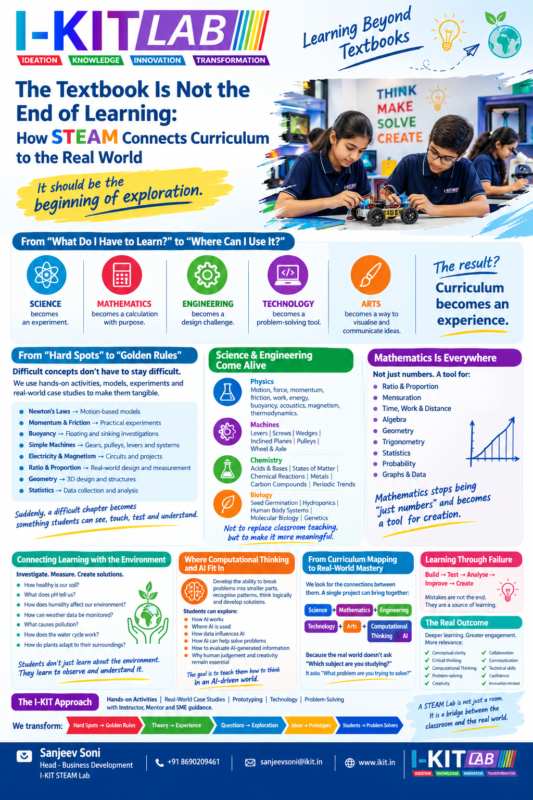
At I-KIT STEAM Lab, we believe that the textbook should not be the end of learning.
It should be the beginning of exploration.
From “What Do I Have to Learn?” to “Where Can I Use It?”
One of the biggest challenges in school education is the gap between academic concepts and real-world application.
Students often ask: “Where will I use this?”
- STEAM provides an answer.
- Science becomes an experiment.
- Mathematics becomes a calculation with purpose.
- Engineering becomes a design challenge.
- Technology becomes a problem-solving tool.
- Arts becomes a way to visualise and communicate ideas.
- The result?
- Curriculum becomes an experience.
Turning Academic “Hard Spots” into “Golden Rules”
Every curriculum has concepts that students find difficult.
We call these “Hard Spots.”
Instead of expecting students to simply memorise them, I-KIT uses hands-on activities, models, experiments and real-world case studies to make these concepts tangible.
For example:
- Newton’s Laws → Motion-based models
- Momentum & Friction → Practical experiments
- Buoyancy → Floating and sinking investigations
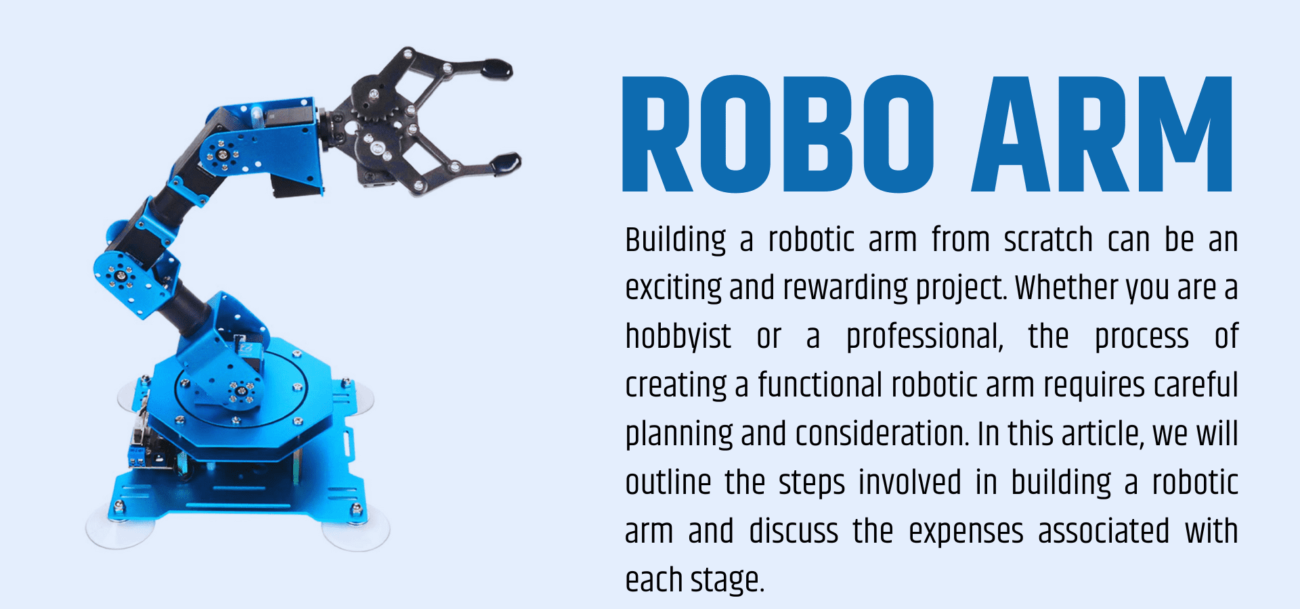
- Simple Machines → Gears, pulleys, levers and mechanical systems
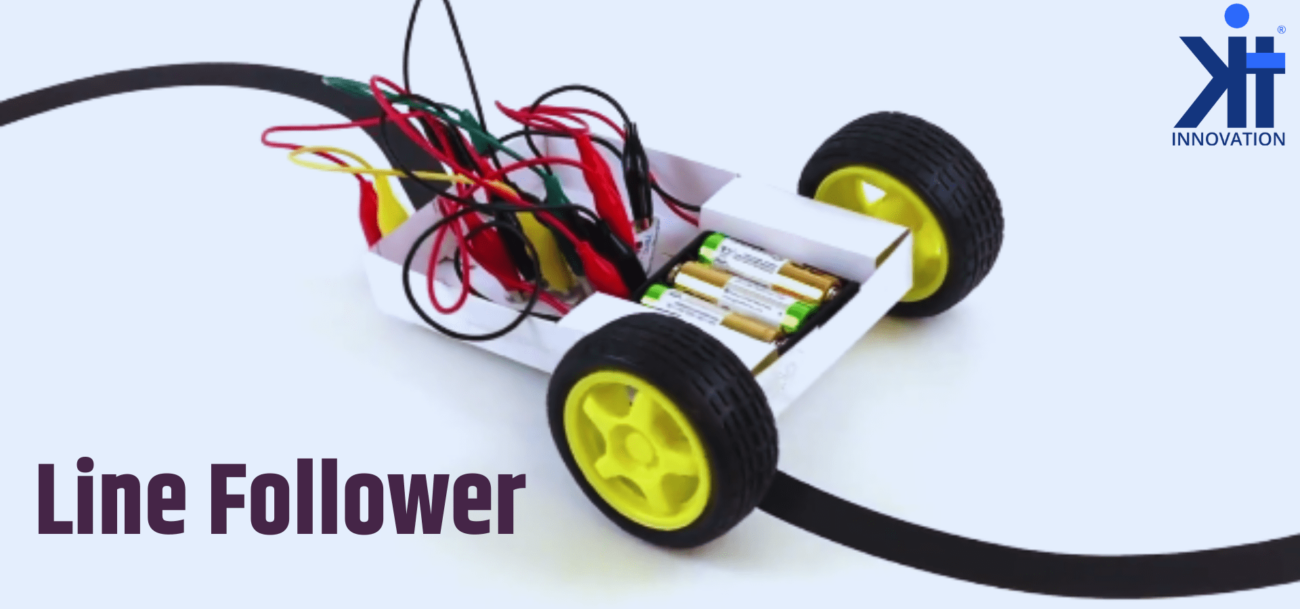
- Electricity & Magnetism → Circuits and electronic projects
- Ratio & Proportion → Real-world design and measurement
- Geometry → 3D design and structures
- Statistics → Data collection and analysis
Suddenly, a difficult chapter is no longer just a chapter.
It becomes something students can see, touch, test and understand.
Science & Engineering Come Alive
Physics is not only about formulas.
Students can explore motion, force, momentum, friction, work, energy, buoyancy, acoustics, magnetism and thermodynamics through practical models and experiments.
Simple and compound machines can be experienced through:
Levers | Screws | Wedges | Inclined Planes | Pulleys | Wheel & Axle
Chemistry can move beyond definitions through exploration of:
Acids & Bases | States of Matter | Chemical Reactions | Metals | Carbon Compounds | Periodic Trends
Biology can become an investigation through:
Seed Germination | Hydroponics | Human Body Systems | Molecular Biology | Genetics
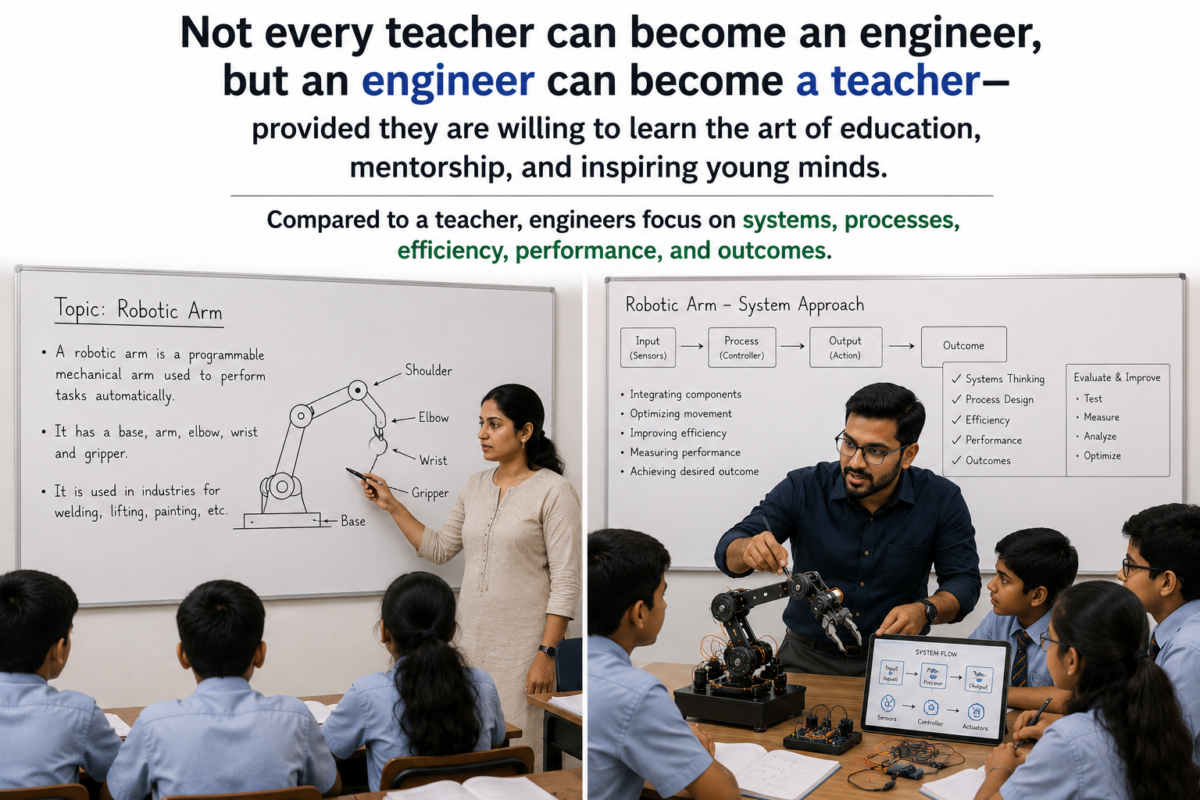
The objective is not to replace classroom teaching.
It is to make classroom teaching more meaningful.
Mathematics Is Everywhere
Mathematics becomes powerful when students realise that it is not only about solving questions on paper.
It is used to measure, design, predict, compare and make decisions.
STEAM activities can connect mathematical concepts such as:
- Ratio & Proportion
- Mensuration
- Time, Work & Distance
- Algebra
- Geometry
- Trigonometry
- Statistics
- Probability
- Graphs & Data
with practical situations.
- A student designing a model is using mathematics.
- A student analysing experimental results is using statistics.
- A student working with dimensions and angles is using geometry.
- Mathematics stops being “just numbers” and becomes a tool for creation.
Connecting Learning with the Environment
Education becomes more meaningful when students can investigate the world around them.
STEAM projects can connect curriculum with real environmental questions:
- How healthy is our soil?
- What does pH tell us?
- How does humidity affect our environment?
- How can weather data be monitored?
- What causes pollution?
- How does the water cycle work?
- How do plants adapt to their surroundings?
These questions bring together Science, Mathematics, Technology and Environmental Studies.
Students don’t just learn about the environment.
They learn to observe and understand it.
Where Computational Thinking and AI Fit In
Today’s students are growing up in a world where AI, automation and digital technology are becoming part of everyday life.
But using technology is not the same as understanding it.
STEAM learning can develop Computational Thinking—the ability to break problems into smaller parts, recognise patterns, think logically and develop systematic solutions.
AI can then become a powerful tool for exploration, creativity and problem-solving.
Students can begin to understand:
- How AI works
- Where AI is used
- How data influences AI
- How AI can help solve problems
- How to evaluate AI-generated information
- Why human judgement and creativity remain essential
The goal is not simply to teach students how to use AI.
The goal is to teach them how to think in an AI-driven world.
From Curriculum Mapping to Real-World Mastery
This is where the I-KIT approach becomes different.
We don’t look at Science, Mathematics, Technology or Engineering as isolated areas.
We look for the connections between them.
A single project can bring together:
Science + Mathematics + Engineering + Technology + Arts + Computational Thinking + AI
That is the real power of STEAM.
Students begin to understand that the real world does not ask:
“Which subject are you studying?”
It asks: “What problem are you trying to solve?”
Learning Through Failure
A student may build a prototype that doesn’t work.
That’s okay.
Because the next question becomes:
Why didn’t it work?
Then:
What can I change?
Then:
Can I test it again?
This creates a powerful learning cycle:
Build → Test → Analyse → Improve → Create
Students learn that mistakes are not simply something to avoid.
They can be a source of learning.
The Real Outcome of Curriculum Integration
The purpose of connecting STEAM with the curriculum is not to add more pressure on students.
It is to make learning deeper, more engaging and more relevant.
Students develop:
● Conceptual clarity
● Critical thinking
● Computational Thinking
● Problem-solving
● Creativity
● Collaboration
● Communication
● Technical skills
● Confidence
● Innovation mindset
Most importantly, they begin to understand why they are learning something.
The I-KIT Approach
At I-KIT STEAM Lab, our pedagogy is built around one simple belief:
Don’t teach a concept only for the examination. Give students a reason to understand it.
We connect curriculum concepts with:
Hands-on Activities | Real-World Case Studies | Prototyping | Technology | Problem-Solving
supported by Instructor, Mentor and Subject Matter Expert (SME) guidance.
Our aim is to transform:
Hard Spots → Golden Rules
Theory → Experience
Questions → Exploration
Ideas → Prototypes
Students → Problem Solvers
A STEAM Lab should not be considered an additional room where students go occasionally to “do activities.”
It can become a bridge between the classroom and the real world.
Because when students can see a concept, they understand it.
When they can build it, they remember it.
When they can test it, they question it.
When they can improve it, they master it.
And when they can create with it, they begin to innovate.
The textbook gives students knowledge.
STEAM gives them a reason to use it.
And that is where real learning begins.