






By Mr. Gopal Krishan Sharma (Founder: PADMANABH Innovations LLP)
STEAM Education Consultant | Robotics & Innovation Educator
Introduction
As schools across India continue their journey toward implementing the vision of the National Education Policy (NEP) 2020, a significant transformation is taking place in the way students learn. NEP 2020 emphasizes experiential learning, critical thinking, creativity, innovation, design thinking, skill development, inquiry-based learning, multidisciplinary education, and the real-world application of knowledge. As a result, terms such as STEAM Labs, Robotics Labs, Innovation Labs, Maker Spaces, and Skill Education have become increasingly common in educational discussions.
Yet, despite their growing popularity, one major misconception continues to persist among educators, school leaders, management teams, and even parents:
“A STEAM Lab is simply a room filled with robots, innovation maker kits, and technology.”
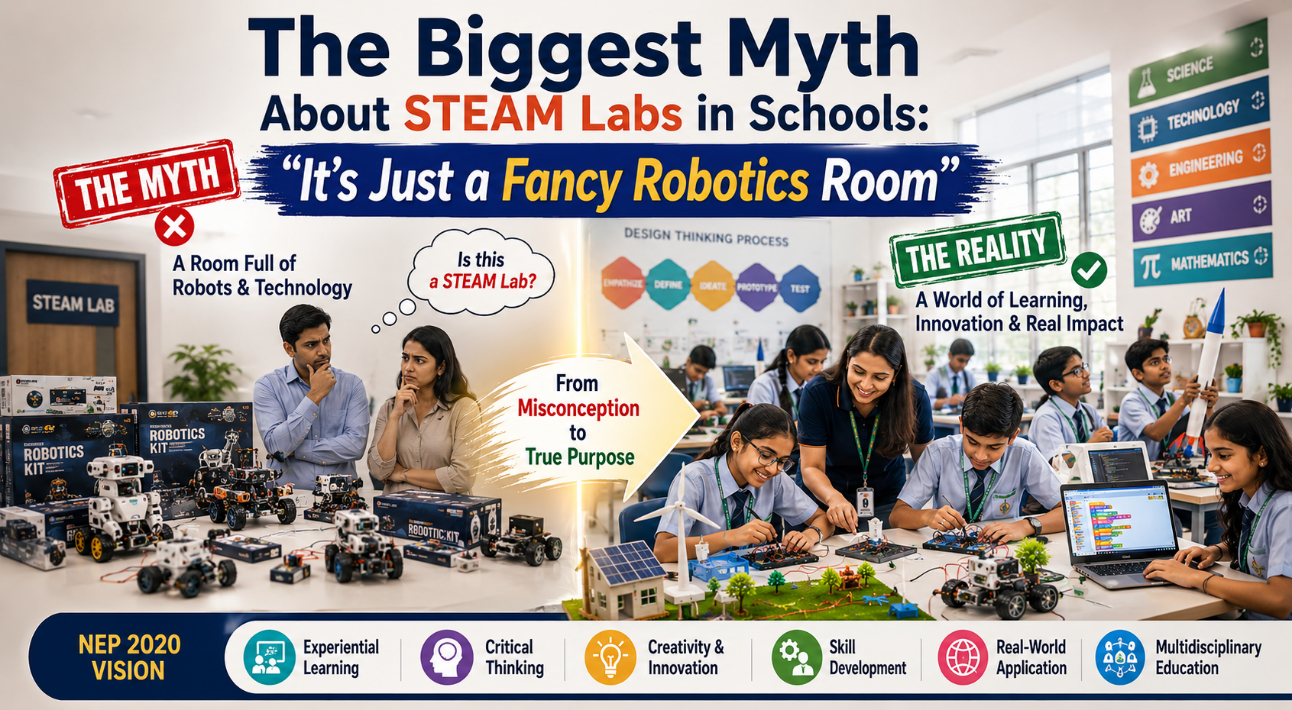
A Misconception That Extends Beyond Technology
The principles promoted by NEP 2020 are universal and applicable across all educational boards and learning environments. Whether a school follows CBSE, CISCE, or a State Board curriculum, and whether it is located in an urban or rural setting, the goals remain the same: to develop creativity, collaboration, critical thinking, communication, innovation, and problem-solving abilities while nurturing the 21st Century Skills required for success in a rapidly evolving global landscape. At its core, NEP 2020 advocates a shift from rote learning to real-world doing, encouraging students to learn through exploration, experimentation, hands-on experiences, and the practical application of knowledge.
What STEAM Really Means
STEAM stands for Science, Technology, Engineering, Arts, and Mathematics. It is not a separate subject or an additional burden on schools; rather, it is an interdisciplinary approach that connects these domains to make learning more meaningful, engaging, and relevant to the real world.
The true essence of STEAM lies in integrating knowledge from multiple disciplines to solve real-world problems, foster innovation, and encourage creative thinking. Instead of learning subjects in isolation, students apply concepts from Science, Mathematics, Technology, Engineering, and Arts simultaneously through hands-on projects, investigations, design challenges, and prototype development.
By combining analytical thinking with creativity, STEAM helps learners develop essential 21st Century Skills such as critical thinking, problem-solving, collaboration, communication, design thinking, innovation, computation thinking and entrepreneurship.
What a Real STEAM Lab Looks Like
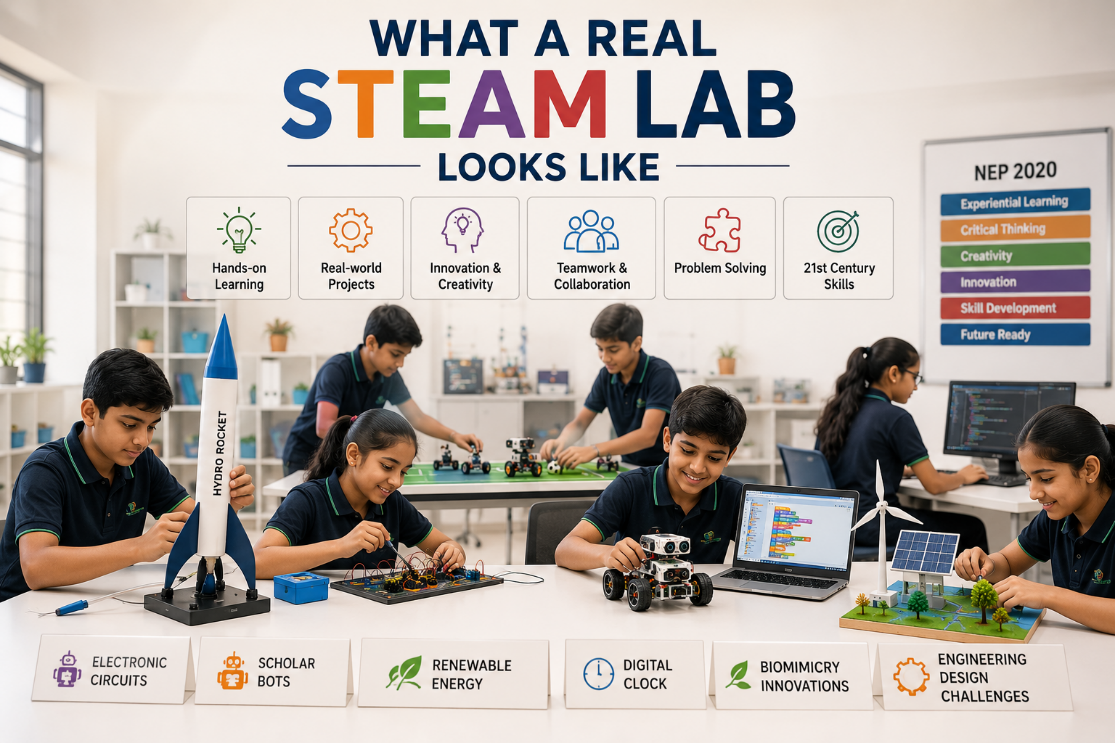
In a well-designed STEAM Lab, students work on real-world projects and hands-on challenges aligned with their age, learning level, and curriculum objectives. Rather than simply observing concepts in textbooks, learners actively apply them through projects such as Hydro Rockets, Scholar Bots, Electronic Circuits, Renewable Energy Models, Digital Clocks, Smart Devices, Biomimicry Innovations, and Engineering Design Challenges.
Learning extends beyond project development through engaging activities and competitions such as Robo Soccer, Robo War, Tug of War Robots, and other robotics-based challenges that make problem-solving, teamwork, and innovation both exciting and meaningful. Students also explore computational thinking and programming through platforms such as Scratch, Python, and C++, developing logical reasoning and digital literacy skills under the guidance of trained instructors, mentors, and subject matter experts.
This experiential learning approach transforms students from passive recipients of knowledge into active creators, innovators, and problem-solvers, enabling them to connect classroom concepts with real-world applications while developing essential 21st Century Skills.
STEAM Lab Is Not a Collection of Random Activities
A common misconception is that STEAM education consists of random activities, isolated projects, or occasional technology demonstrations. In reality, every STEAM activity is carefully planned, curriculum-mapped, and aligned with specific learning objectives.
Whether a school follows CBSE, CISCE (ICSE), a State Board, or any other academic framework, STEAM experiences are designed grade-wise and subject-wise to complement classroom learning. Each project, challenge, or activity is intentionally connected to concepts students are already studying, ensuring that learning remains relevant, age-appropriate, and academically meaningful.
This structured curriculum alignment transforms STEAM from a collection of activities into a purposeful educational approach that bridges the gap between theory and real-world application.
A STEAM Lab Is Not Built by Equipment Alone
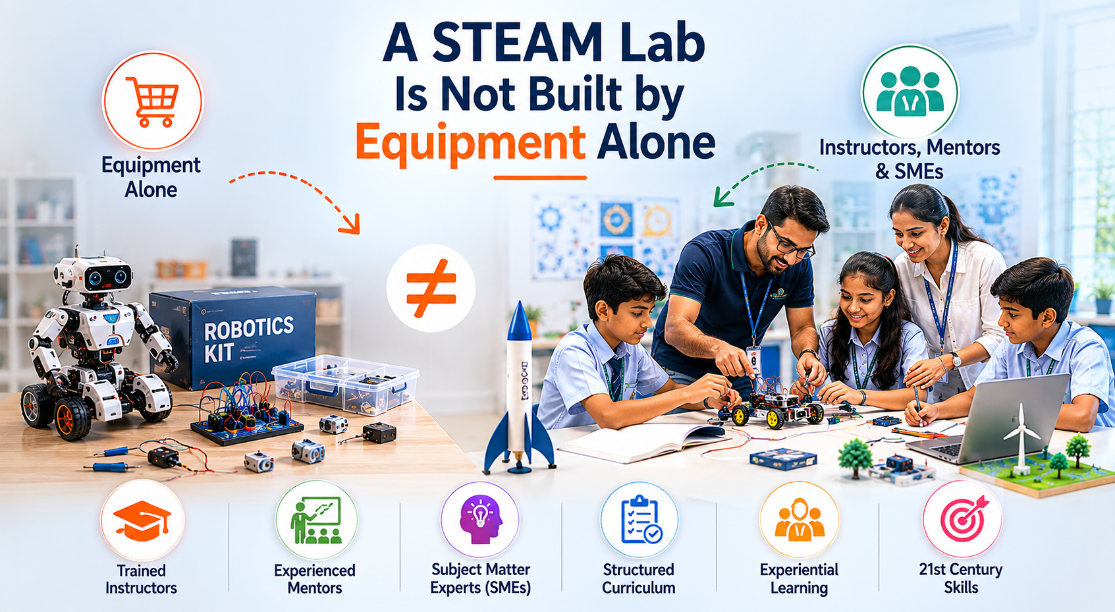
One of the most common misconceptions about STEAM education is that a school can establish a STEAM Lab simply by purchasing robotics kits and appointing a robotics teacher. While technology and equipment are important, they are only tools—not the foundation of effective STEAM learning.
A genuine STEAM Lab is built on trained instructors, experienced mentors, subject matter experts (SMEs), a structured curriculum, and well-designed experiential learning methodologies. These professionals guide students through inquiry, experimentation, design thinking, problem-solving, and innovation while ensuring that learning remains curriculum-aligned, age-appropriate, and relevant to future technologies.
Together, instructors, mentors, and SMEs transform tools and kits into meaningful learning experiences, helping students develop creativity, critical thinking, collaboration, communication, and other essential 21st Century Skills. Ultimately, a true STEAM Lab is defined not by the technology it contains, but by the quality of learning experiences it creates.
Why This Myth Exists
For decades, education has largely been associated with textbooks, examinations, and rote memorization. As schools transition toward experiential learning, many stakeholders still tend to evaluate a STEAM Lab by the equipment it contains rather than the learning experiences it creates. Since robotics, is often the most visible component of a STEAM Lab, it is frequently mistaken as the destination, when in reality it is just one of many tools used to foster creativity, innovation, critical thinking, and real-world problem-solving.
Conclusion
A STEAM Lab is not defined by the equipment it contains but by the learning experiences it creates. It is a space where students transform ideas into solutions, questions into discoveries, and knowledge into innovation. Technology may fill a laboratory, but only educators, mentors, curriculum experts, and a culture of innovation can transform it into a true STEAM learning environment.
STEAM is not about robots. It is about reimagining how students learn, think, create, and innovate.
The goal is not to build robots. The goal is to build thinkers, creators, innovators, problem-solvers, and future-ready minds it inspires.
Absolutely agree. Many Schools invest in infrastructure but often overlook the human element behind successful STEAM implementation. Skilled instructors, mentorship, and a well-designed learning framework are what truly transform a lab into a center for innovation and 21st century future-ready learning.