




By Mr. Gopal Krishan Sharma
Founder, PADMANABH Innovation
STEAM Education Consultant | Robotics & Innovation Educator
Introduction:
The rapid adoption of STEAM, Robotics, Artificial Intelligence, Coding, and Emerging Technology Programs in schools has created exciting opportunities for engineers to enter the field of education. Across the world, schools are investing in innovation labs, robotics programs, and experiential learning environments to prepare students for the future-ready minds.
As a result, many engineers have transitioned from industries, manufacturing units, software companies, automation firms, and technical organizations into classrooms as Robotics Instructors, Mentors, SMEs (Subject Matter Experts), Coding Trainers, and STEAM Educators.
The journey to becoming a STEAM Lab Educator does not happen overnight. Engineering teaches us how things work. Education teaches us how minds work. A successful STEAM educator must understand both.
At first glance, the transition appears natural. Engineers possess technical knowledge, problem-solving abilities, future-ready minds and hands-on experience with technology. However, many soon discover an important reality: Knowing how technology works is not the same as knowing how students learn.
The journey from engineer to STEAM educator is not simply a career change. It is a transformation of mindset, perspective, and purpose. It is a journey that moves beyond machines and focuses on nurturing curiosity, creativity, innovation, and future-ready skills in young minds.
The Common Misconception:
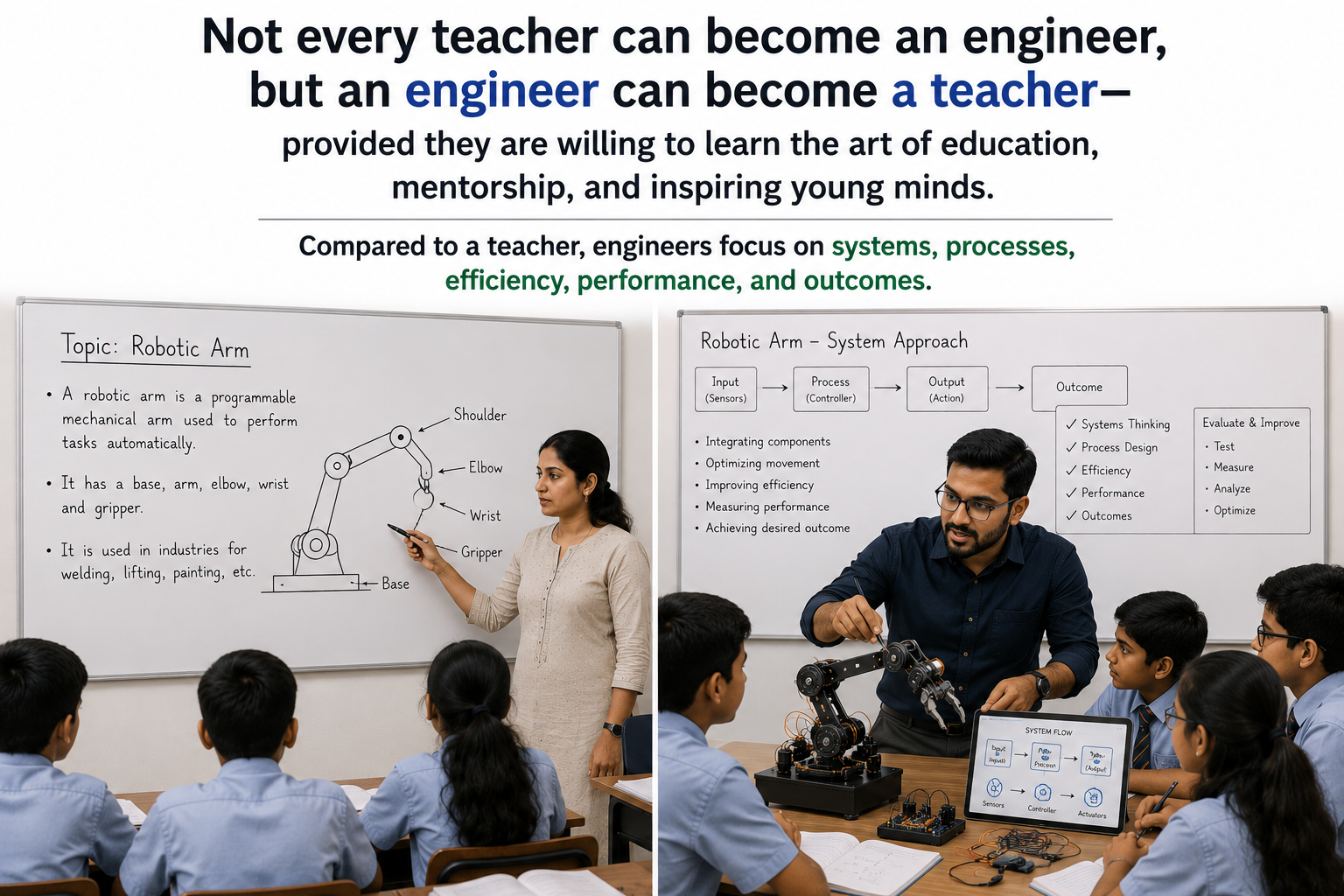
One of the biggest misconceptions in STEAM education is that an engineer can instantly become a great STEAM educator, or that a teacher can become an engineer simply through technical training. In reality, effective STEAM education requires a unique blend of technical expertise, pedagogy, mentorship, and experiential learning skills.
While technical expertise is undoubtedly important, effective teaching requires a completely different set of competencies.
A brilliant engineer may successfully design a robotic system, develop software, or solve complex technical challenges. However, helping a classroom full of students understand, explore, and apply those concepts requires additional skills that extend far beyond engineering. Teaching is not the transfer of information. It is the facilitation of learning.
From Building Machines to Shaping Young Minds:
In industry, engineers focus on systems, processes, efficiency, performance, and outcomes. In education, the focus shifts toward:
- Student engagement
- Learning experiences
- Curiosity development
- Conceptual understanding
- Creativity and innovation
- Individual learning styles
- Confidence building
A machine behaves according to programmed instructions. Students do not. Every learner enters the STEAM Lab with unique experiences, interests, strengths, challenges, and aspirations. A successful STEAM educator learns to understand these differences and adapts teaching approaches accordingly.
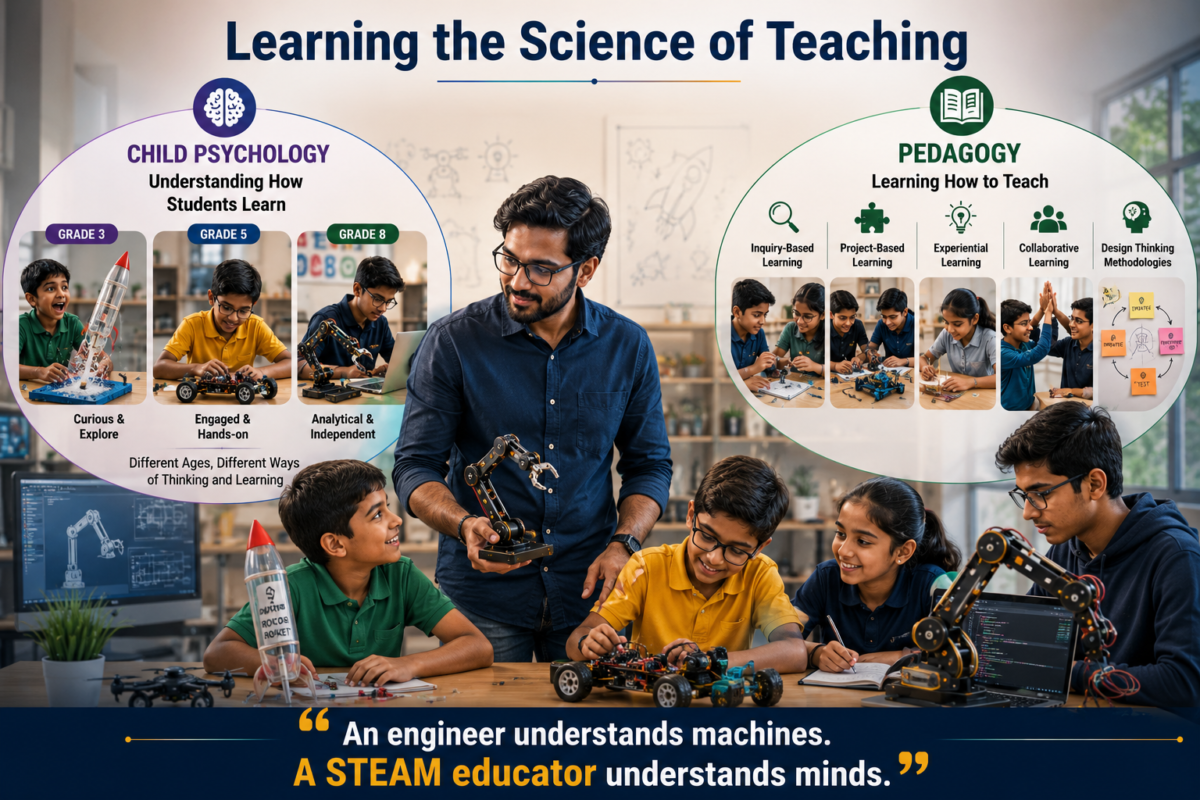
Learning the Science of Teaching:
Many engineers who enter the field of STEAM education soon realize that teaching is a skill that requires continuous learning and improvement and they must understand:
Child Psychology: Every child has a unique way of thinking and learning, which changes at different stages of their growth and development.
- Students at different age groups think differently.
- An activity that excites a Grade 3 student may not engage a Grade 8 learner.
- Knowing how students learn and develop helps teachers provide age-appropriate learning experiences.
Pedagogy: Pedagogy is the way a STEAM educator helps students learn and understand new concepts.
- Rote learning to real – world doing
- Inquiry-Based Learning
- Project-Based Learning
- Experiential Learning
- Collaborative Learning
- Design Thinking Methodologies
Connecting Technology with Real-World Learning:
One of the biggest transformations for an engineer entering education is realizing that technology is not the final goal of learning. A robot, a coding project, or a working prototype may look impressive, but they are only tools that support the learning process.
Over time, educators learn that the real purpose of these activities is to help students think critically, solve problems, work collaboratively, communicate ideas, and develop creativity and innovation. The focus gradually shifts from simply building projects to creating meaningful learning experiences. A successful educator learns how to use technology to make learning more engaging, practical, and relevant to real-world situations. This shift in perspective transforms an engineer from a technical expert into a mentor who helps students develop the skills and mindset needed for the future.
Integrating STEAM with the school curriculum:
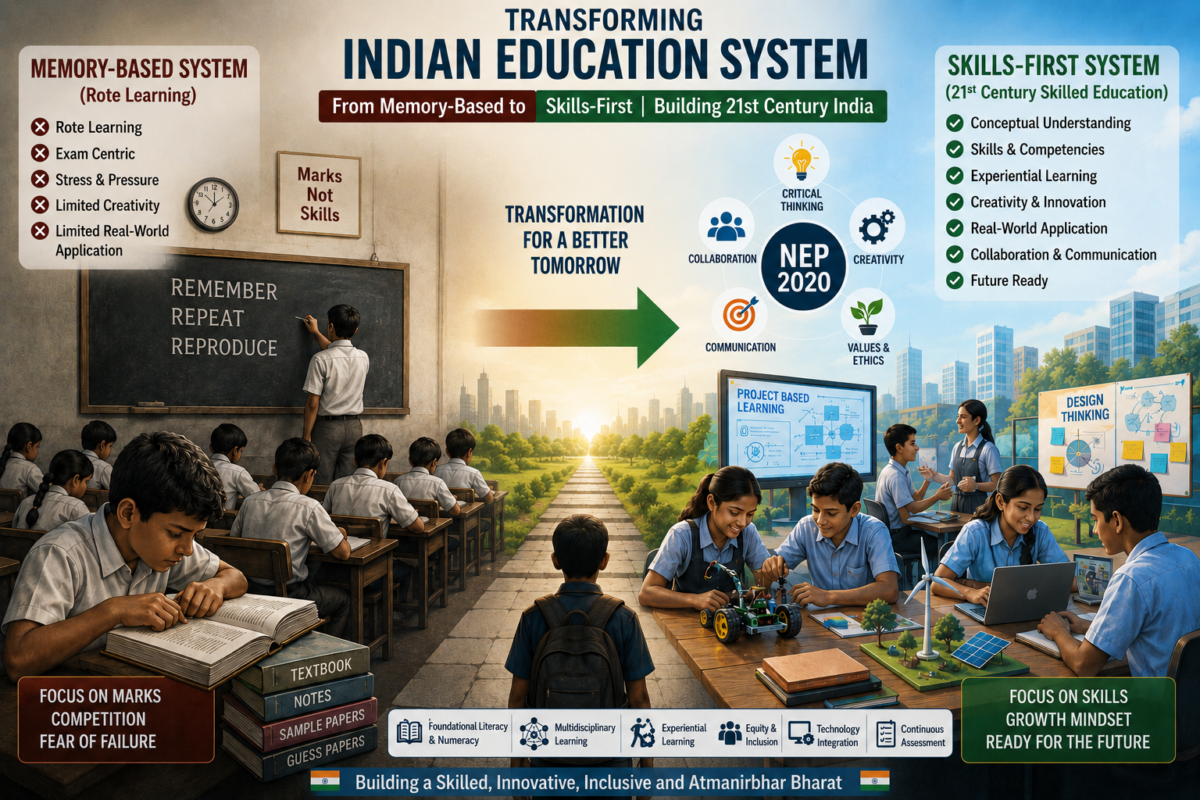
This transformation has become even more important with the implementation of the National Education Policy (NEP) 2020. The policy encourages schools to move beyond rote learning and embrace experiential, competency-based, and multidisciplinary education. It emphasizes critical thinking, creativity, problem-solving, and real-world application of knowledge while promoting meaningful connections across different subject areas. As a result, learning becomes more relevant, engaging, and closely linked to real-life situations.
One of the most important transformations for engineers entering education is learning how to connect technology-based activities with the school curriculum. In schools, learning is most effective when new concepts are linked to subjects that students already study in their classrooms. An educator must understand how hands-on activities can support concepts from Science, Mathematics, Social Studies, Languages, Art, and other subjects. Rather than teaching technology as a separate topic, the focus is on creating meaningful learning experiences that help students apply classroom knowledge in practical situations.
From Teaching Concepts to Inspiring Ideas – Inquiry-Based Learning:
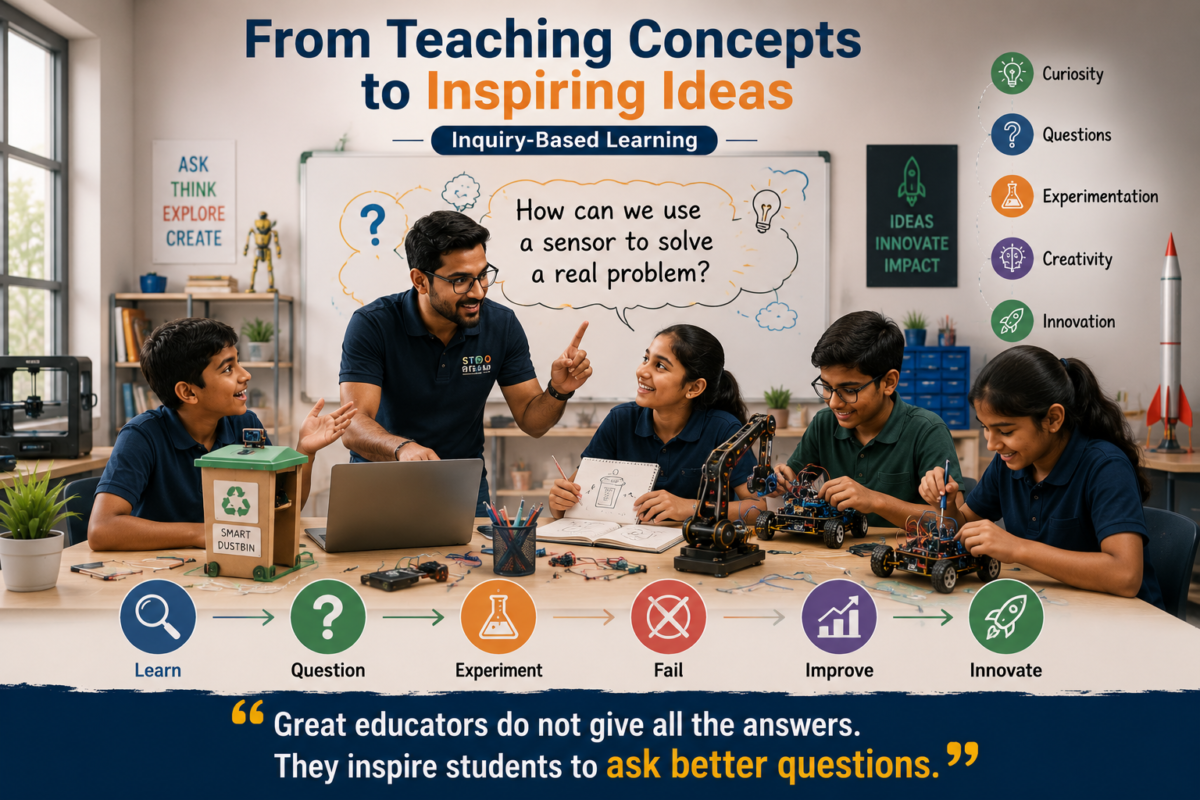
- How a sensor works.
- How a motor rotates.
- How a robot moves.
They should learn:
- Why problems exist.
- How technology can solve them.
- How ideas can become innovations.
- How failures contribute to improvement.
The transformed educator creates opportunities for students to ask questions, experiment, take risks, and learn from mistakes.
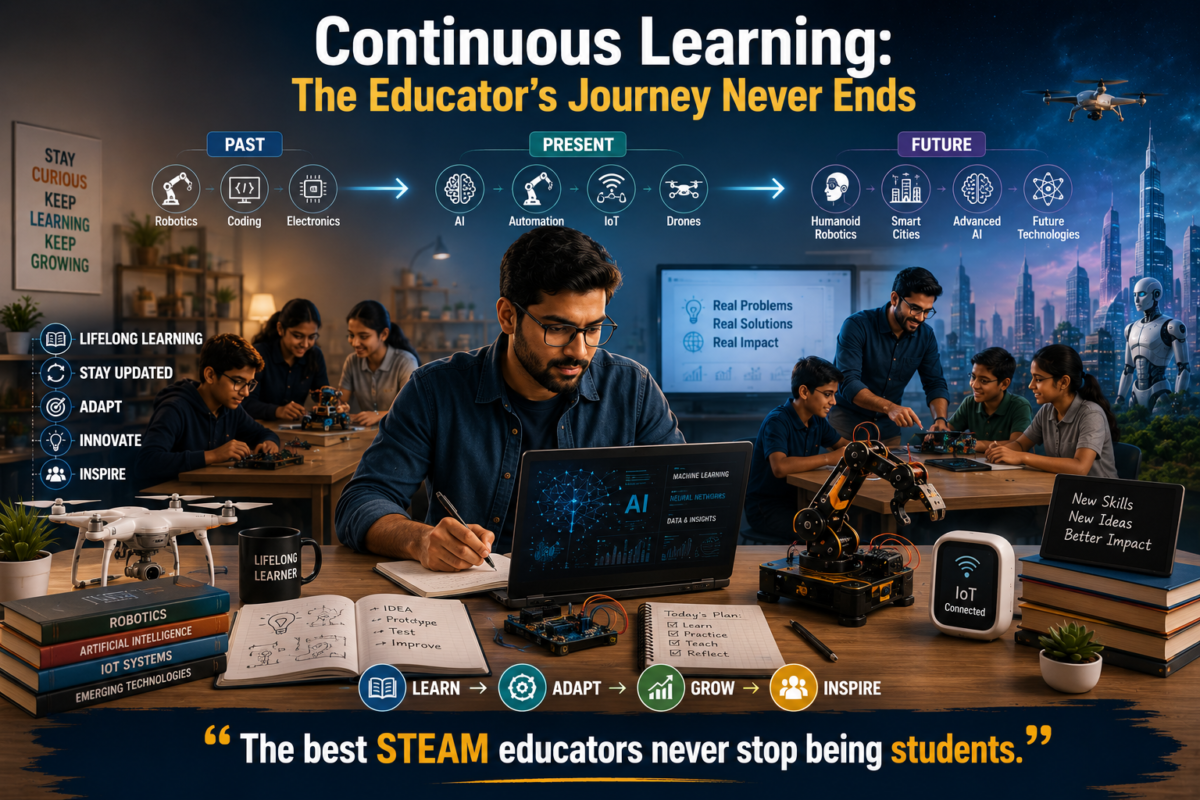
Continuous Learning: The Educator’s Journey Never Ends:
One of the first things engineers realize when they enter the field of education is that learning never stops. Technology is changing very fast, and new innovations are becoming part of our daily lives. Fields such as Artificial Intelligence (AI), Robotics, Automation, IoT, Drones, and other emerging technologies are continuously transforming the way we work, learn, and solve problems. To stay relevant and effectively guide students, educators must keep learning and updating their knowledge.
A successful STEAM educator always continues to learn. They keep updating their knowledge of new technologies while also improving their teaching skills and understanding of how students learn.
This habit of continuous learning helps educators stay updated, effective, and ready for the changing needs of the future. In the world of STEAM education, the moment an educator stops learning, their teaching begins to become outdated.
Conclusion:
The journey from engineer to STEAM educator is one of the most meaningful transformations a professional can experience. It begins with technical expertise but ultimately grows into something much larger—a commitment to shaping future innovators, problem-solvers, creators, and leaders.
Engineering teaches us how technology works. Education teaches us how young minds learn. A successful STEAM educator must understand both.
A STEAM educator helps young minds imagine possibilities, transform ideas into innovations, and develop the confidence to create the future.
In the end, the true measure of a STEAM educator is not the number of robots built inside a laboratory. It is the number of students inspired to think differently, solve meaningful problems, and believe that they too can change the world.
“The real success of an engineer-turned-educator is not teaching robots or technology, but inspiring students to ask questions, think differently, and keep learning throughout life.”