We go beyond
Passive Learning
to inspire Hands-on Innovation

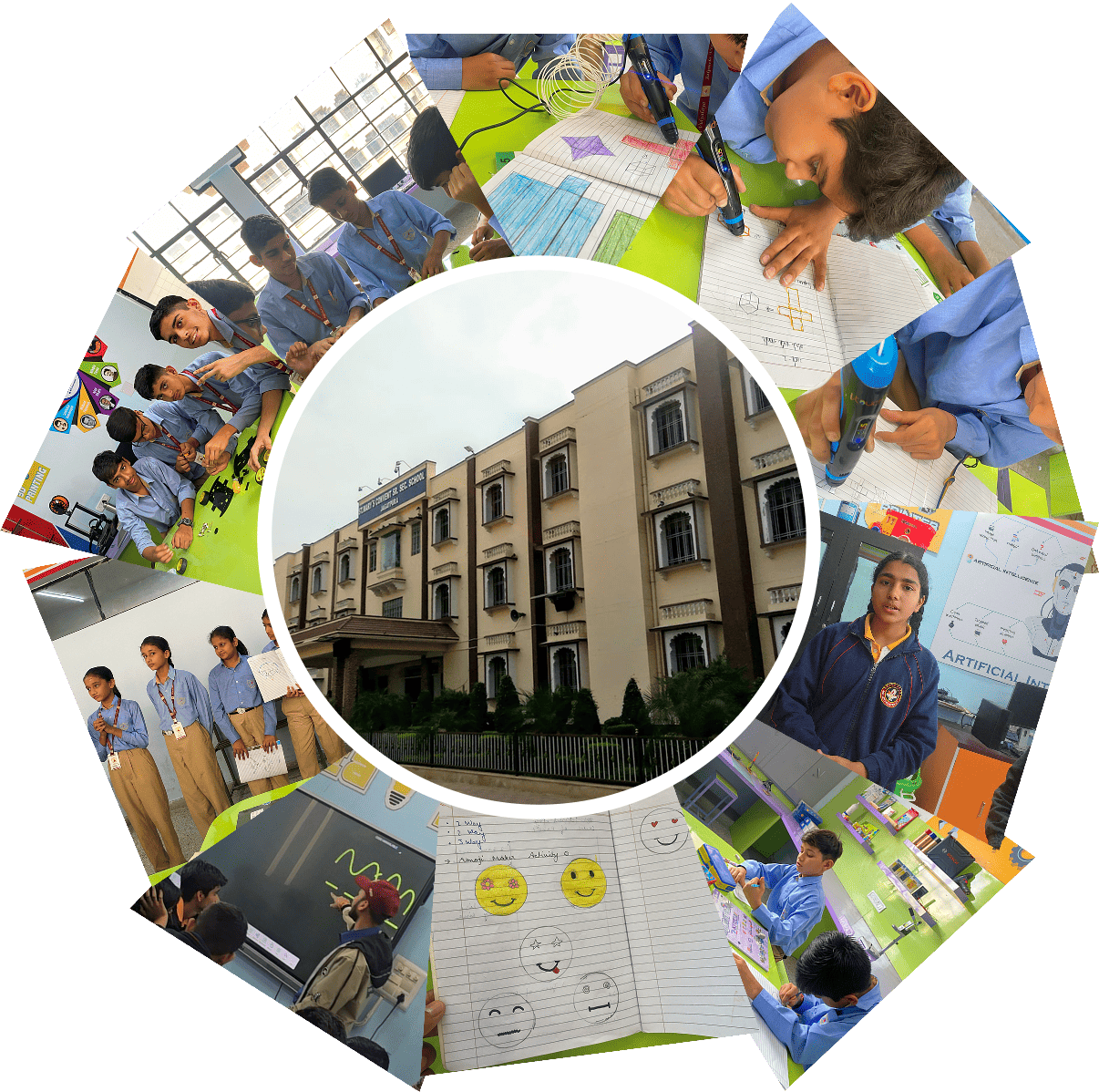
At St. Mary’s Convent Sr. Sec. School, we believe in moving beyond rote learning to hands-on innovation through our advanced STEAM Lab powered by I-KIT LAB. The lab integrates Robotics, Artificial Intelligence (AI), Mechatronics, Coding, and IoT to provide students with real-world skills, critical thinking, and experiential learning in a future-ready environment.

Hands-On Learning Tracks

ROBOTICS

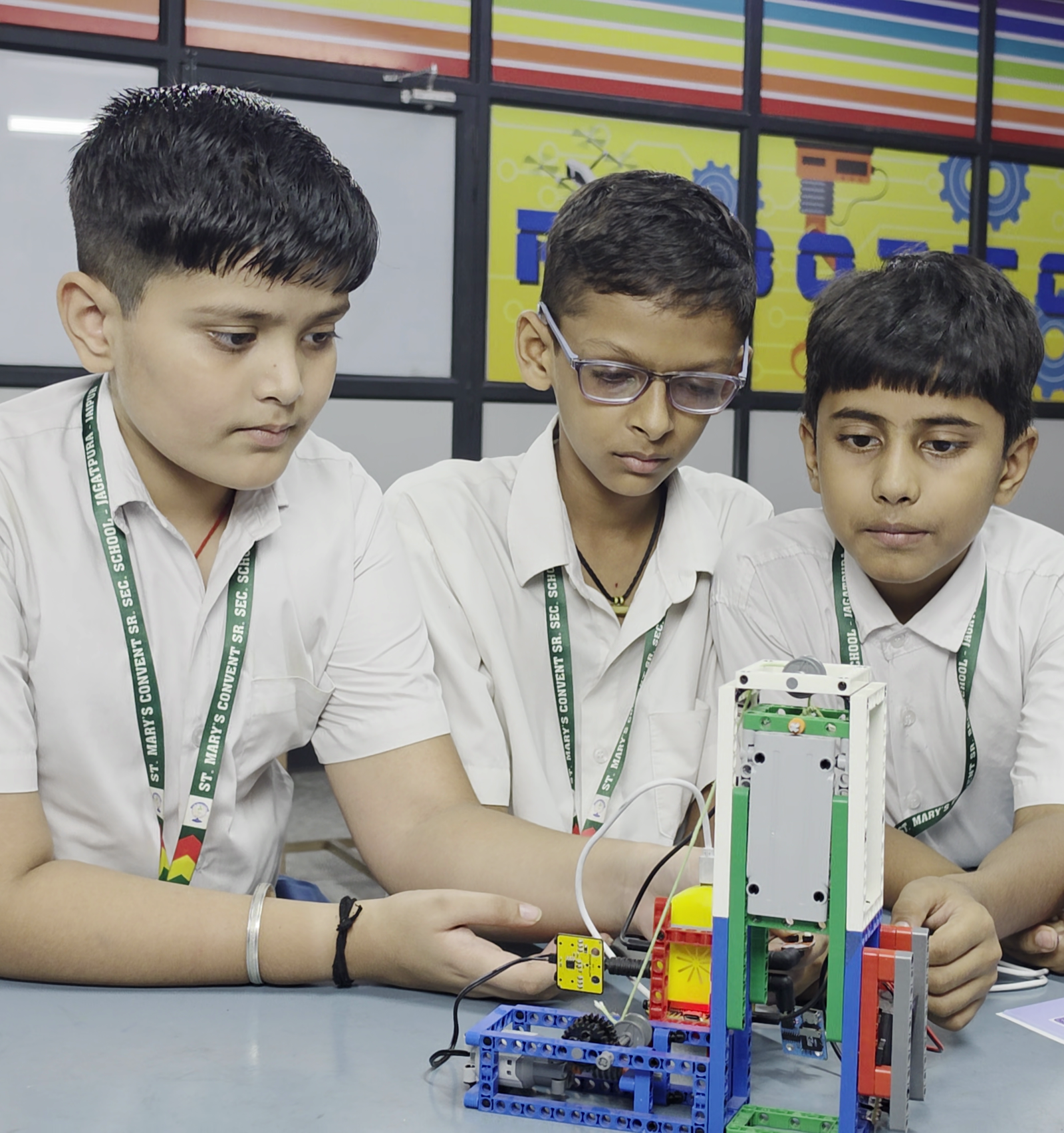
Robotics introduces students to the exciting world of designing and building smart machines. Through hands-on activities, students learn how to create and program robots using sensors, motors, and controllers. It helps develop creativity, logical thinking, and problem-solving skills while making learning fun and interactive.

MECHATRONICS

Mechatronics combines mechanics, electronics, and programming to create automated systems. Students learn about basic machines, circuits, sensors, and coding in an easy and practical way. It builds a strong foundation for innovation and helps students understand how modern machines and technologies work.

AI

Artificial Intelligence helps students understand how machines can learn and think like humans. They explore concepts like machine learning, computer vision, and language processing through simple projects and real-life examples. AI learning enhances analytical thinking and prepares students for future technologies.
unnamed
unnamed
unnamed

STEAM Education

Learning Beyond Classrooms


STEAM (Science, Technology, Engineering, Art, and Mathematics) is more than just a curriculum—it is an integrated approach to learning that prepares students for real-world challenges. At our STEAM Lab, students don’t just study theories; they experiment, create, and innovate, making learning exciting and meaningful.

Together, Science, Technology, Engineering, Art, and Mathematics create a holistic learning experience. STEAM education equips students with creativity, critical thinking, and problem-solving skills—preparing them to become innovators, change-makers, and leaders of tomorrow.

 Pillars of STEAM

SCIENCE

unnamed

In the Science section, students unlock the secrets of nature by exploring fascinating concepts like gravity, force, inertia, and Newton’s laws of motion. They dive into the world of electricity, conductors, magnets, optics, mirrors, lenses, and waves, while also discovering the wonders of the circulatory system, bio diversity, anatomy, food science, agriculture, the environment etc. Through hands-on experiments- connecting main stream education with the real world.

TECHNOLOGY

unnamed

Technology is the bridge between creativity, out of box thinking, and innovation. Working together and finding new solution/process for real-world problems. They discover the impact of technology on building a sustainable future, exploring topics such as renewable energy, resilient agriculture, biomimicry, and green innovations.
Through project designing and process development, students experiment with new-age technologies, learning how creativity and digital tools can transform ideas into practical solutions for society.

ENGINEERING

unnamed

Engineering is where imagination turns into reality. Students design, build, and test models while applying real-world principles of structures, mechanics, and energy. From simple machines to complex prototypes, they learn to brainstorm, collaborate, and innovate.
Every project encourages teamwork and problem-solving, leading students to create functional engineering products that combine creativity, innovation, and sustainability.

ART & MATH

unnamed

Art and Mathematics together spark creativity and logic. Students explore design, visual arts, 3D modeling, and craftwork while applying maths concepts like geometry, symmetry, patterns, and proportions. By blending imagination with precision, they create functional and visually appealing models—building both problem-solving and creative expression skills for innovation.

DELVERY MECHANISM

unnamed

Every topic starts with an application-focused question, engaging students with lab materials.

Inquiry Based Learning

unnamed

Students experiment with DIY kits to collect data, formulate observations, and interpret findings.

DIY Kits

unnamed

Students build projects addressing real-world problems by fusing Art, Math, Science, and Technology.

Project Based Learning

STEAM Benefits

For Students

  • Builds confidence & problem-solving skills
  • Converts complex topics into simple concepts through experiments
  • Encourages creativity & innovation
  • Reduces dependency on rote learning & extra coaching

For Parents

  • Reduces financial load of external tuitions
  • Equips children with 21st century skills for future employability
  • Ensures holistic development

For Teachers

  • Access to modern teaching tools & training
  • Supports collaborative lesson planning
  • Reduces workload with structured STEAM framework

STEAM Learning Outcomes?

  • Holistic Education Approach: The school emphasizes experiential learning, integrating practical activities with classroom teaching to make concepts more engaging and memorable.
  • Interdisciplinary Learning: By blending Science, Technology, Engineering, Arts, and Mathematics, the school fosters a well-rounded approach to innovation and problem-solving.
  • Critical Thinking Culture: Students are encouraged to tackle challenges that develop analytical and problem-solving skills essential for real-world success.
  • Future-Ready Education: The school prepares learners for upcoming career opportunities by introducing them to modern tools, technologies, and methodologies.
  • Confidence and Growth: Participation in projects and activities builds self-confidence, enhances creativity, and strengthens students’ overall personality.
  • Guidance and Mentorship: Teachers and mentors provide personalized support, ensuring the academic and personal growth of every student.
  • Active Learning Resources: With DIY kits and activity-based learning, the school promotes hands-on engagement that deepens understanding and improves long-term retention.

STEAM in Action

Transforming Education Through STEAM Learning at St. Mary’s Convent Sr. Sec. School

Education is no longer limited to textbooks and traditional teaching methods. In today’s fast-changing world, students need practical exposure, critical thinking skills, and technological understanding to succeed. Recognizing this need, St. Mary’s Convent Sr. Sec. School has taken a significant step forward by introducing the I-KIT STEAM Lab—an advanced learning space designed to transform the way students learn and innovate.

Unlike conventional classrooms, the STEAM Lab provides a hands-on environment where students actively engage in experiments, projects, and real-world problem-solving. This approach bridges the gap between theory and practice, ensuring that learning becomes meaningful, interactive, and impactful.

What is the I-KIT STEAM Lab at St. Mary’s Convent Sr. Sec. School?

The I-KIT STEAM Lab is an advanced learning space where students explore Science, Technology, Engineering, Arts, and Mathematics through hands-on experiments and real-world projects.

How is STEAM education different from traditional learning?

Unlike traditional learning, STEAM focuses on practical application, creativity, and problem-solving rather than just theoretical knowledge.

Which classes can participate in the STEAM Lab?

The STEAM Lab is designed for students across multiple grade levels, with activities tailored according to their age and learning capacity.

What skills do students gain from STEAM learning?

Students develop critical thinking, creativity, teamwork, communication skills, and technical knowledge in areas like robotics, coding, and AI.

Does the STEAM Lab help in career development?

Yes, it provides early exposure to advanced technologies and builds skills that are essential for careers in engineering, technology, and innovation-driven fields.

What kind of projects do students work on ?

Students work on robotics models, AI-based applications, IoT systems, drones, and various engineering projects that simulate real-world challenges.

How does the STEAM Lab improve academic performance?

By making concepts practical and engaging, students understand subjects better, which leads to improved academic performance and deeper learning.

Is STEAM education important for the future?

Yes, STEAM education is essential as it prepares students for future technologies, innovation, and evolving career opportunities.